Reading Georgette Heyer: Powder and Patch
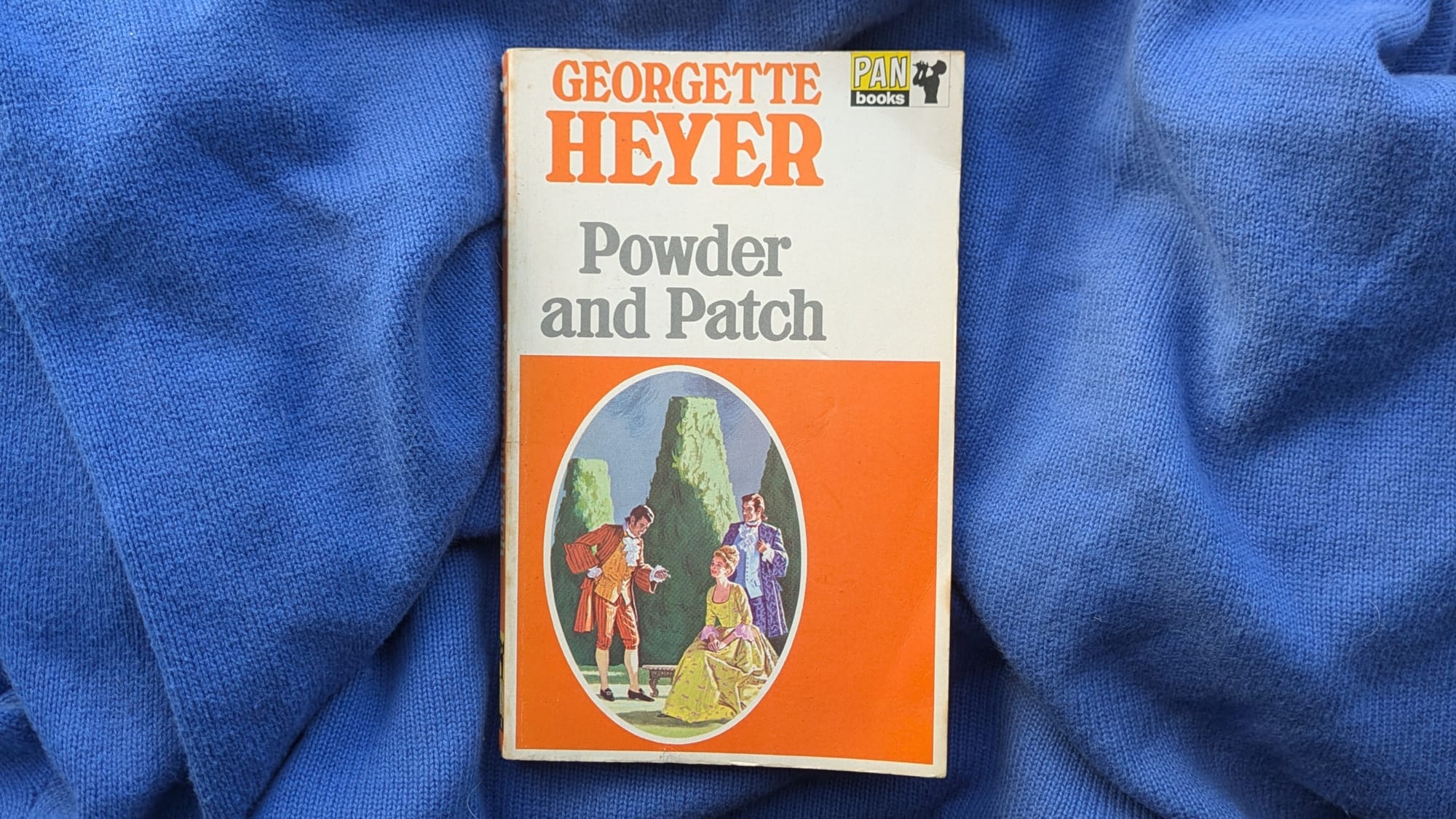
I've gone back in time: both fictionally, because this novel is once more set during the reign of George II in the 1750s, and biographically, because this was only the third book that Georgette Heyer ever published. After following the Alastair-Audley tetralogy through to its conclusion, I'm now going to return to some of the titles from the 1920s and early 1930s that I skipped while in the grip of my passion for all things Devil/Satanas and their descendants.
Powder and Patch is an anomaly in Heyer's bibliography. It was her only novel ever to be published pseudonymously and also her only one to be put out by Mills & Boon (which at the time was a general interest publisher, its concentration on romances only beginning in the 1930s). Unusually, this novel differs a fair bit between its two major editions. In 1923, it appeared as The Transformation of Philip Jettan by Stella Martin. Then it was reissued in 1930 by Heinemann as Powder and Patch by Georgette Heyer, minus its original final chapter. It's also very short: my Pan paperback edition is only 159 pages. According to Jennifer Kloester, Heyer wrote it in just three weeks. Compare this to last week's Napoleonic behemoth: my copy of An Infamous Army is 412 pages.
Powder and Patch is a delicious morsel. It centres on Philip Jettan, as the original title would suggest, a young man from a wealthy gentry family. Philip's father, Sir Maurice, was a great one for fine clothes, high society and extravagant travel in his youth. He had hopes, we are told, that his son would follow in his footsteps, but disappointingly Philip prefers the English countryside and dressing more for comfort than style. Philip is also passionately in love with the daughter of Sir Maurice's neighbour. Her name, if you'll believe it, is Cleone.
The status quo is shattered by the arrival in the neighbourhood of a rival for Cleone's hand. Mr Bancroft marches down the village street in a suit of pale apricot and high, red-heeled shoes. The residents gawp at him and immediately dub him an "Apparition". Cleone — herself considered a "Vision" — is flattered by his courtly manners and perpetual compliments. Straightforward, unrefined Philip seems very boring by comparison. When he asks her to marry him, she refuses him on the grounds that he has no polish or refinement. And so, of course, he vows to show her by going away and becoming the most refined gentleman who has ever minced into a ballroom. His pride is further injured when he loses dismally in a fencing match with Bancroft. Better swordsmanship is also to be part of his transformation.
Much of this book is taken up with the details of Philip's evolution into a figure of fashion. I've learned that Heyer is fond of using a physical transformation as part of a character's development. In These Old Shades we get Léonie's shift from boy to girl and her opinions about having to wear skirts instead of breeches as a way of indicating her fiery and unconventional character. This book expands on that: Powder and Patch is one long Georgian makeover montage, if you will, as Philip Jettan is transformed from diffident country bumpkin into society exquisite and le dernier cri of fashion. In both instances, an older character acts as their fairy godmother or guide through the process — for Léonie, it's her future sister-in-law Fanny, and for Philip it's his uncle Tom, a rackety younger son with good taste in cravats. They head to Paris, which is to be the testing-ground for Philip's new persona.
Philip takes Parisian society by storm with his magnificent outfits, excessive languor and witty repartee. He soon has a circle of admiring friends and more invitations than he can handle. Heyer is careful not to make him too much of a paragon or a fashion plate, though, which would make him boring in a different way. No amount of beautifully fitted coats can change his essential nature. He is still fundamentally decent and competent, for all that he postures as an unreliable poet. His verses are laughably bad, though. Despite the new plumage, he's still at heart a country squire, not a creative genius. Some things can't be changed by the haresfoot or the skill of a brilliant tailor.
He returns to London, where Cleone is having a rather successful season of her own. Of course a comedy of errors ensues, with both parties pretending they aren't still attached and flirting vindictively with other people. In this section, we get to meet Cleone's aunt, Lady Malmerstoke, who espouses an interesting if rather essentialist philosophy of love. She warns Cleone against flirting too much with other men to enrage Philip, because "men with chins like his are not safe", which is a great phrase. Later, Lady Malmerstoke tries to explain to Philip why Cleone is doing the opposite of going after what she wants — that is, flirting with others rather than showing her partiality for Philip. "Women don't reason," she says, which is all very Men Are from Mars, Women Are from Venus.
Then later still, she tells Philip that he must be "brutal" to Cleone, and "master" her, and kiss away her objections. Up to this point, he's been too polite and respectful to win her. I think there is an interesting point buried in here — Cleone wants Philip to be interesting and exciting, rather than staid and boring — but words like "brutal" and "master" come a little close to suggesting he should override her objections or force her into doing things she doesn't want to do. Which isn't at all indicated with these characters, but the hint is there that a less courteous suitor might take it too far. Which is, after all, an accurate representation of how some men behaved, and behave, towards women. This is the closest thing I've yet seen in Heyer to the stereotypical "strong man and swooning woman" of pure romance fiction, and a far cry from her subtler take on such a relationship, like that of Dominic and Mary in Devil's Cub. Mary has much greater agency and autonomy than Cleone does. Maybe that's the difference between the 1750s and the 1780s.
Another interesting element, as a modern reader, is Lady Malmerstoke's "little black page", Sambo. His dialogue and action are limited only to announcing guests with a slight indication of his accent — he pronounces "Sir" as "Sah", for instance. We learn nothing more about him, other than that his mistress is polite to him and he does his job well. We don't know where he came from or how old he is, although the epithet "little" suggests he's younger than the typical eighteenth century servant, so likely quite a young child. His presence in the novel hints at the darkness that underpins all of this froth and fun, recalling the truth of how some of these fortunes are maintained and that in this era, some kinds of human beings were kept like pets for display. I don't think that Heyer includes him for this reason — she's not writing a novel about imperialism or the slave trade — but rather because it's historically accurate that a woman of this class and at this time might have such an attendant. It was fashionable, and the characters of Powder and Patch are, above all things, fashionable.
This story concludes, of course, with Philip being masterful and resolving all of Cleone's romantic difficulties — she has accidentally betrothed herself to two men she doesn't like in the same night. In the original version, there is then a final chapter with Philip, Cleone and Sir Maurice in Paris, all being highly exquisite and admired together. It's a resolution of a sort, with Philip's father finally proud of his son and the young lovers safely married. When the book was republished by Heinemann, though, Heyer chose to omit this conclusion and end with Philip and Cleone in London, betrothed and happy. The implication of this ending is that Philip has learned not to be diffident and boring, but isn't going to devote his life to the pursuit of the perfect waistcoat. He's got his girl and they are going to make a life together. It's a more mature and interesting way to bring the novel to a close, showing how much Heyer had developed her craft in the seven years between the two editions.
As the shortness of this book indicates, there isn't great depth to be found in Powder and Patch. It is, however, excellent fun — full of period details about mid eighteenth century fashion and society. I would absolutely read this book again if I felt in need of cheering up.
My Favourite Phrases
- Philip's father, Sir Maurice, describes his son near the start of the book as "a raw clodhopper".
- Philip calls Bancroft, an early rival for Cleone's hand, a "pranked out mummer".
- Once he has morphed into a man of fashion, Philip has a "middle aged exquisite" to tie his cravat.
- Cleone's aunt, Sally Malmerstoke, calls Philip's father "a punctilious ramrod".
Thanks for reading. I'm making making way through Georgette Heyer's historical novels — you can find all the entries so far here.
You can support my work with a recurring contribution or leave a one-off tip.
Member discussion