Reading Georgette Heyer: Regency Buck
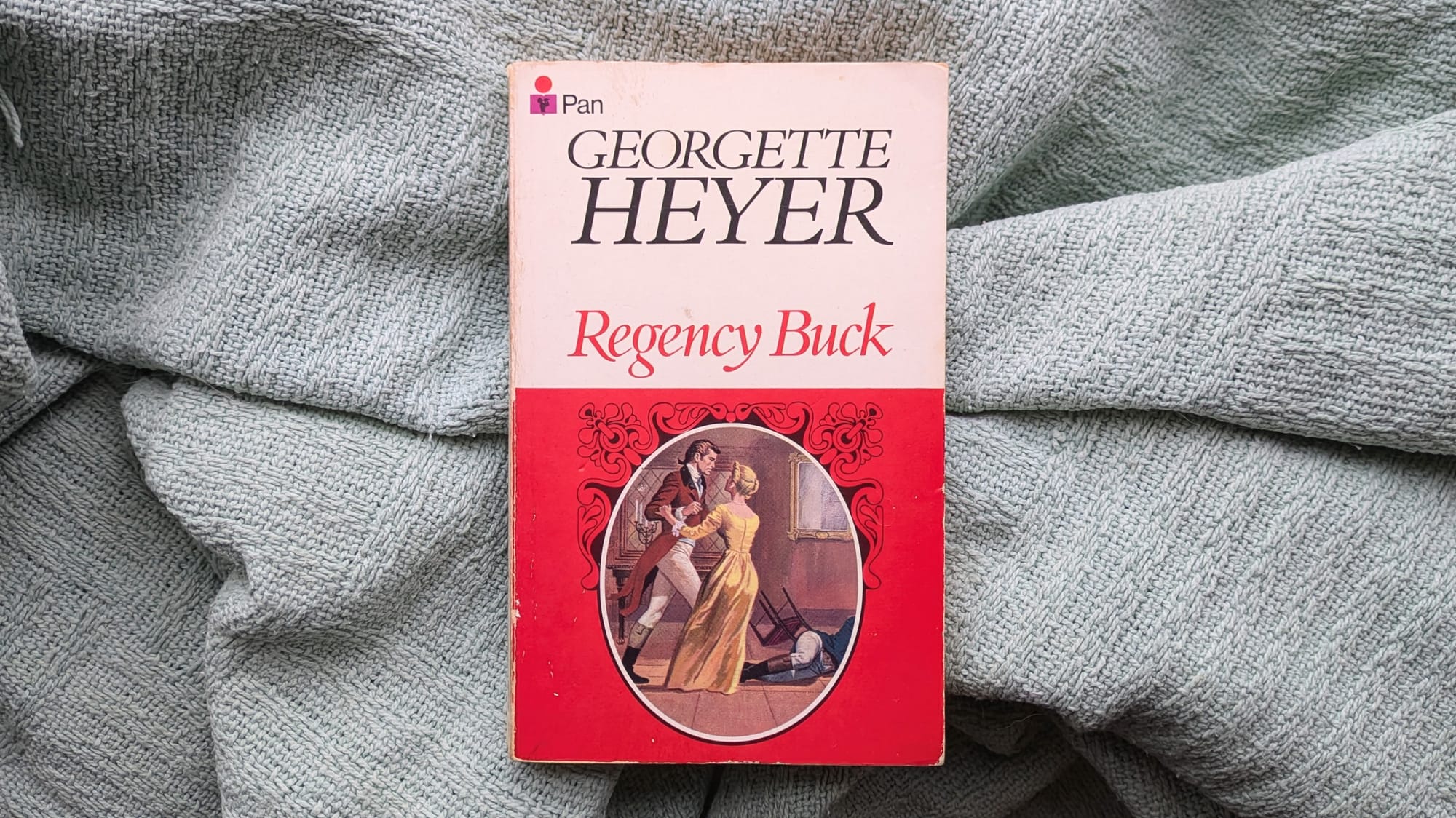
I really wanted to like Regency Buck. Although I've enjoyed all of my Georgette Heyer reading so far, I was particularly excited to arrive at one with "Regency" in the title. She's most famous for fiction set in this period and now, after my introductory sojourn in the 1750s and the 1780s, I thought I had arrived at the main event. And this is, most certainly, a novel set during the Regency. In fact, the historical details of that period came at me so thick and fast that it was easy to forget that there was also a story somewhere underneath.
The problem is, I think, that Heyer was also very excited to have arrived at the Regency. It's a fascinating period of history, to be sure: there was much change and upheaval socioeconomically and politically, as well as in fashion, culture and architecture. I understand the impulse to research it thoroughly — and according to Jennifer Kloester's biography of Heyer, she did exactly this, borrowing lots of books from the London Library. The novel that she produced from all of this reading is very heavy on non-fiction elements, to the detriment of its quality as fiction.
Untangled from all the historical detail, Heyer's plot has promise. It centres around a wealthy but still underage brother and a sister — Judith and Peregrine Taverner — who have decided to abandon their boring life in Yorkshire for the social whirl of London society. Once there, they spar with their reluctant yet overbearing guardian, the Earl of Worth, while enjoying the riding, the clothes and the parties that match their new lives as young rich people on the town. Perry has various escapades, including a duel, while Judith revels in her status as a desirable heiress.
Partway through, everyone relocates to the seaside and we get one of the best sequences of the book, in which Judith and Perry race their curricles from London to Brighton. This section is both truly exciting and just revealing enough of the historical details involved in such an enterprise. The same goes for the account of Perry's duel, which is a rare point of suspense in the book, and for Judith's uncomfortable encounter with the Prince Regent at the Pavilion. That was the one moment where I felt she became a real character rather than a mere cipher, as she suddenly realised that she had allowed herself to be manoeuvred into a private room, alone, with a powerful and predatory older man. These glimpses of a better balance between plot and research give me hope for the Regency novels I've yet to read.
Once in Brighton, family jealousies come to a head, there are not one but two abductions, and eventually Judith decides that her guardian is much better suited to being her husband. In her appraisal of this book, Mari Ness compares the plot unfavourably with that of Pride and Prejudice and with hindsight I can see the similarities, but while I was reading the book I noticed none of that romantic misunderstanding or tension. Since the Earl of Worth gets little dialogue that isn't about paying his wards' debts or forbidding their wilder hobbies, his "romance" with Judith doesn't feel earned or even real. It compares unfavourably to the way the growing harmony between Dominic and Mary is gradually revealed in Devil's Cub.
So much for my disappointment in Regency Buck as a work of fiction. I did, however, find it to be a fairly readable non-fiction introduction to Regency society. Many of Heyer's characters are real historical figures, with special prominence accorded to Beau Brummell, the Duke of Clarence and the Prince Regent. There are lots of period set pieces that are described in evocative detail, such as a boxing match at a country inn, a London cock fight, an evening at Almack's, and a soiree at the Pavilion in Brighton. The sections that deal with how Brummell curated trends and started fashions are interesting, as is the deep dive into the appeal of snuff.
But oh, the name-dropping is endless! This is a celebrity tour of the Regency era disguised as a novel. There are just so many needless cameos from real historical figures that do nothing to advance the plot, such as an appearance by Lord Byron and one from Matthew Lewis, author of The Monk. Jane Austen also gets a little mention, although she isn't personally present. And while I did enjoy the Wikipedia rabbit hole I went down to learn more about "the Clarke scandal", it similarly had no real relevance to this novel.
Heyer's deep knowledge of her period settings is one of the main things readers enjoy about her historical fiction. In the other novels I've read so far, she deploys a deft touch in blending history with fiction, such as in the brief appearance of Louis XV and Madame de Pompadour during the Versailles scenes in These Old Shades. In Regency Buck, though, it feels as though she was just so keen to disseminate facts about the Regency that she allowed her research to crowd out all the other wonderful things she could do.
Other Thoughts
- I loved the description of the Earl of Worth's bed. It's enormous, supported by bronze gryphons and topped by a red silk canopy. So opulent.
- There are more masculine-only spaces in this book that I've experienced in Heyer so far, such as the crowd for the boxing match and cock fight, the boxing gym that Worth and Peregrine frequent, and the parlour at Cribb's pub.
- This novel takes an unexpected turn into being quite Christmassy for a bit — there is a festive section spent in the snow at Worth's country estate.
- Poisoned snuff is such a funny means of murder. I wonder why Heyer didn't try it in her detective fiction.
Slang Corner
- Early on, Peregrine goes to an inn's dining room to eat a "tight little beefsteak".
- A "turnip watch" is the most elegant kind of timepiece a man can carry.
- At Vauxhall, a fashionable party has "ham shavings and burnt wine in a box".
- "Daffy", meaning gin.
- "Cream pot love", to describe a mercenary marriage proposal to an heiress from a royal duke.
- Peregrine mentions how Worth has bought up his "vowels", meaning his IOUs from gambling.
Thanks for reading. I'm making my way through Georgette Heyer's historical novels — you can find all the entries so far here.
You can support my work with a recurring contribution or leave a one-off tip.
Member discussion