Bonedust, Botanist, Bookshop: What I Read in June 2025
I'm another step closer to being back up to doing real-time monthly reading updates. In June, I managed a lot more reading driven by pleasure and curiosity than last time, and I also varied my formats and genres a bit more, which is one of my overall reading goals for this year.
Problematic Summer Romance by Ali Hazelwood
I consumed this as an audiobook, which I had decided by about a third of the way in was a mistake. I read Hazelwood's formulaic romances because I find them restful for an otherwise-busy brain. Unfortunately, the audio production here was too distractingly bad to make it a relaxing experience. The book is split between first person narration from Maya, an American twenty-something with a debilitating crush, and Conor, the Irish, thirty-something friend of her older brother who is the object of her affections. Two audiobook narrators take it turns to read the alternating viewpoints — a presentation style of which I approve.
However, the narrator voicing Conor seemed to have been recorded in a very different quality of studio to his counterpart. It might even have been a home recording booth or similar. In the audio world, we obsess over this thing called "room tone", which just means the sound of the room used for recording. If you're being very thorough, when you record someone you're supposed to capture a few minutes of just the room's ambient noise, no talking, so that you can make it blend in the edit with the other soundscapes in your final product. It's jarring and a bit tiring for a listener to be constantly adjusting to different levels and types of background noise within a single programme.
I'm probably oversensitive to this kind of thing because I've spent years editing podcasts for a living, but the constant switching between crystal clear studio audio for one character in this audiobook and then something echoey and muffled for the other was too much for me. I did finish, but I was cross.
Bookshops & Bonedust by Travis Baldree
This audiobook, by contrast, was perfect. This was my second time through this story; I first read it as a library ebook in July 2024. Travis Baldree, the author of two immaculately structured cosy fantasy books, is also a professional audiobook narrator as his day job and it's a true pleasure to hear him read his own work. If you are considering trying this story about an orc who gets into reading and helps save a struggling bookshop during her enforced convalescence from a battle injury, may I strongly suggested that you pick it up in audio form.
The Botanist's Assistant by Peggy Townsend
I chose this book on a whim from the many, many press releases I get sent by publishers, because there was something about the description of the protagonist — a talented, middle-aged botanist who lives alone in a small cabin in the woods and ends up solving her boss's murder — that spoke to me. I'm very glad I did, because I devoured this book within 24 hours and found it to be very well written and plotted. I did get an advance copy of it, though, and I'm afraid it's not on general release until 18th November. If you are curious, do consider giving the book a pre-order, adding it to your wishlist on your reading-tracking platform of choice, or requesting it at your library (all are good ways of supporting writers you would like to see keep on writing).
Margaret Finch is an oddball and a misfit who lives entirely according to her own habits, drives an ancient truck, and makes her own soap. She likes things just so, in a way that might be interpreted as being neurodiverse-adjacent, but which plays out via character description rather than a diagnosis being part of the plot. Margaret works as a research assistant in a lab where plant extracts are being used to make medical breakthroughs, until one day her boss, a charismatic and well-known scientist, is found dead in his office. Considered a suspect by the police and determined to carry on their research no matter what, Margaret teams up with the building's new janitor (a former investigative journalist) to solve the case. Her awkward personality traits, for which she has often been teased or bullied, turn out to be an asset when it comes to tracking down a murderer.
Publishing loves to describe books in the format X + Y = Z, and for this one I think that equation would be Lessons in Chemistry + the Ruth Galloway series = The Botanist's Assistant.
The Man in the Dark by John Ferguson
This was a completely unknown book to me, which I read for the Green Penguin Book Club strand of my podcast. My thoughts are available at much greater length in that episode, but in brief: I liked the foggy London opening, enjoyed the complications that came from a blind man witnessing a murder, found the abduction plot implausible, and thought that the ending was badly paced. I was sufficiently amused (and intrigued by Dorothy L. Sayers' positive reviews of his work) to acquire several more Ferguson books since reading this one, and will report back when I eventually get around to reading them.
I can't link to this book, incidentally, because it hasn't been republished anywhere in recent decades and is quite hard to get hold of. If you want to read it, your best chance is to hunt down the Penguin version from the 1930s.
We Solve Murders by Richard Osman
A light romp, heavy on the international travel details. Skews a bit too contemporary for my tastes.
Cover Story by Mhairi McFarlane
I am a confirmed Mhairi McFarlane fan and a book by her that is about both podcasting and journalism was always odds on to be a winner with me. And so it proved. This fake dating, enemies to lovers story between two colleagues at a regional media office gets full marks for vivid, accurate descriptions of both Manchester and the industry. It has all the Mhairi trademarks: quippy dialogue full of smart pop culture references, genuinely heart-wrenching backstories, a romance that builds beautifully without cliché... I don't think this one has quite supplanted 2020's If I Never Met You as my favourite of hers, but it ranks pretty highly. Bonus points to any readers who recognise the inspiration for main character Bel's podcast in actual journalist Maeve McClenaghan real-life show The Tip Off (which is a great listen, by the way).
The Feast by Margaret Kennedy
I don't think I would ever have read this 1950 novel if the Shedunnit Book Club hadn't selected it as our reading choice for July, but I'm incredibly glad I did. It's difficult to categorise: sort of a thriller, sort of literary fiction, sort of a comedy of errors, perhaps wholly something all of its own. The novel narrates the happenings in a chaotic seaside guest house in Cornwall day by day over a week in 1947, with plenty of unpleasant guests, overworked servants, hijinks with ration books, and complaining about post-war income tax. But we read about all of these happenings, minor and major, with a mounting sense of impending doom because the opening prologue has already told the reader that the whole place and everyone in it is going to be buried by a landslide at the end of the week. So in that sense, it is a page-turner with a sensational climax, albeit one with a subtle moral dimension. I loved this book and would highly recommend it.
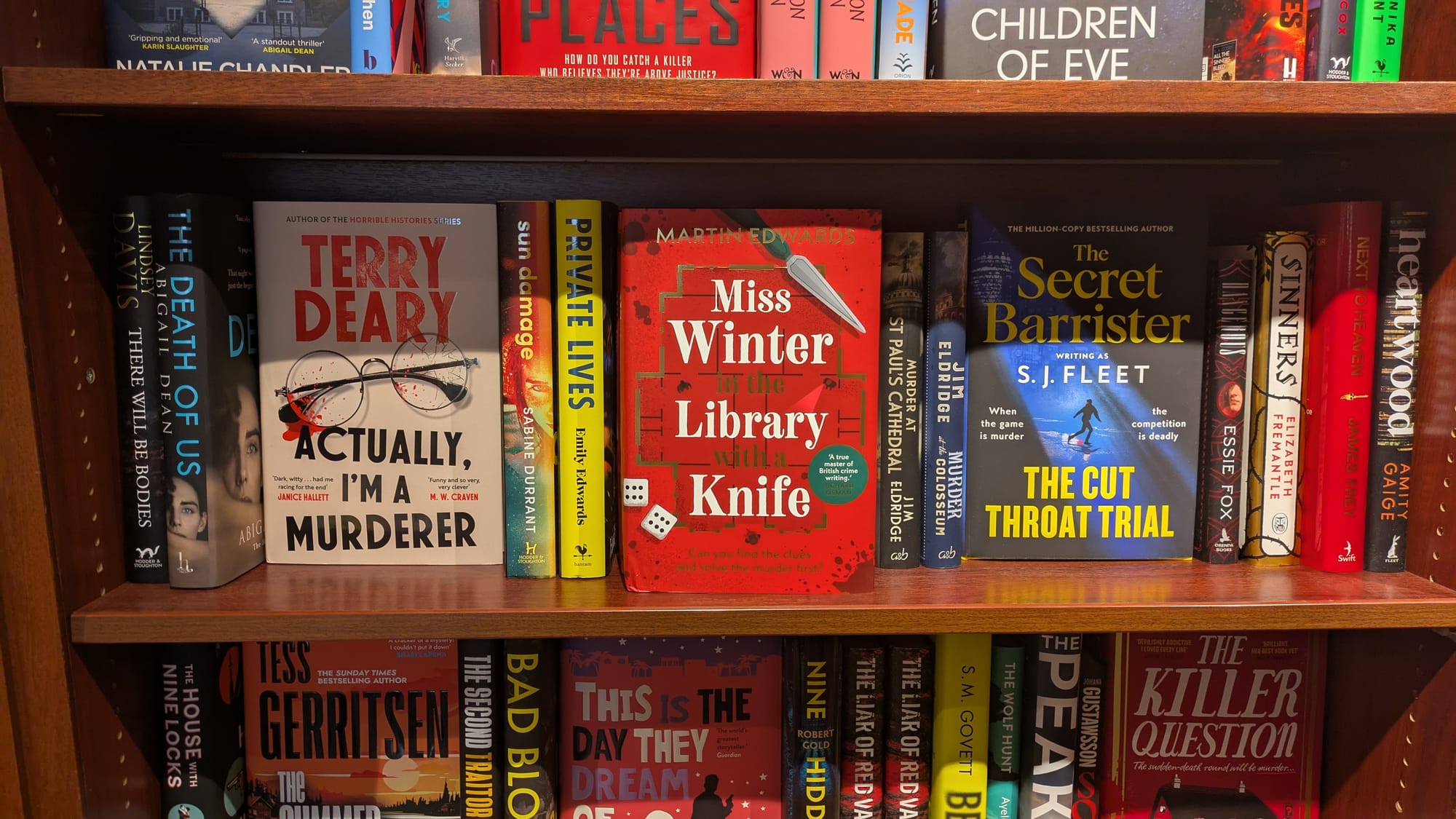
Miss Winter in the Library with a Knife by Martin Edwards
I got to read Martin's new mystery fairly early, because we were making a podcast episode together about cluefinders and it needed to be recorded before summer proper (owing to my habit of removing myself to a remote northern island for weeks at a time). In the current timeline, it was just published last week. He gave himself a lot of constraints with this one: it's a contemporary standalone, set at Christmas, full of solve-along puzzles (I liked the opening Greek riddle) that has a small cast of suspects snowed in at a peculiar village in a remote area of the Pennines. A difficult technical challenge, which he pulled off with plenty of knowing winks to golden age mystery writing and proper clueing. I enjoyed it a lot.
Never Inconstant by Lyndsay Constable
I recently realised that my ongoing and futile quest to read every single Pride and Prejudice continuation in existence was too narrow, and I ought to expand it to include spin-offs of Austen's other novels too. This realisation led me to pick up this follow-on novel to Persuasion. It's written to be both largely epistolary and to have dual timelines, so that we see Anne and Frederick many years after the happy conclusion of the original book but also are taken back to the years of their separation via the discovery of a cache of letters that he furiously wrote but never sent while they were apart. I cannot speak at all to the accuracy of the naval details in this, but I found the narrative jogged along nicely and the characterisation was not egregiously bad. Which, in the Austen continuation world, is high praise indeed.
Death of Mr Dodsley by John Ferguson
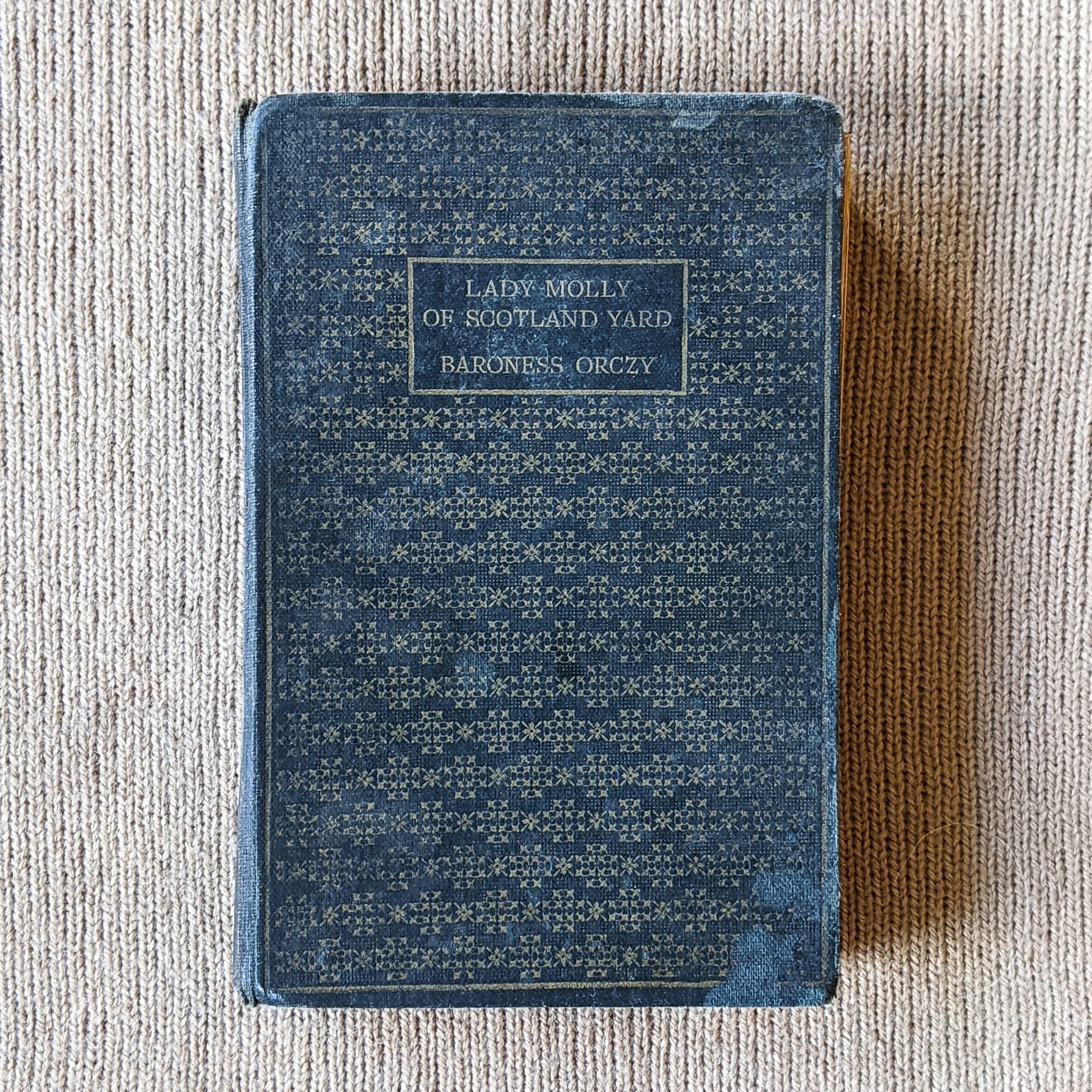
I read this 1937 bookshop mystery initially as part of the preparation for the episode about The Man in the Dark mentioned above (and it then became the inspiration for another one all about bookshop murders specifically). This was the only other John Ferguson novel that I could find in an easily-accessible edition (it was republished by British Library Crime Classics in 2023).
There are lots of things to like about this book. It has a dramatic opening scene in the Palace of Westminster, as MPs are enduring an all night sitting of the House of Commons and waiting for an important vote on a key amendment. Meanwhile, at a secondhand bookshop on the Charing Cross Road, a bookseller named Mr Dodsley is being murdered while a drunk toff is giving two patrolling police officers the runaround on the street outside. There's even a cat that uncovers a key clue and a hand drawn map of the bookshop. All great fun.
Where this book fell short for me was in its pacing. After this promising start we spent what seemed like a very long time with a rather dull police inspector as he questions all the workers in the shop one by one, and this felt repetitive and rather redundant. The narrative momentum improved again later on as Ferguson's recurring sleuth, private investigator Francis McNab, was able to take more initiative in the case, but to my mind the book never wholly recover from its slow middle section. A mixed experience.
Days at the Morisaki Bookshop by Satoshi Yagisawa, translated by Eric Ozawa
The explosion in cosy translated fiction (mostly from Japan) in recent years has rather passed me by — as previously mentioned, I've been reading fairly narrowly the past few years. I don't know if this is the title that kicked off the "gentle fiction set in a Japanese bookshop, restaurant or café" trend, but it's certainly a very successful example of it. And I can see why: Yagisawa's melancholy story about a young woman, Takako, who mends her broken heart by moving into her eccentric uncle's secondhand bookshop is both heartwarming and thought-provoking. I'm not sure I could read too much of this stuff together, though — it would get a bit saccharine — but as an occasional treat, I like it. I will hold the sequel, More Days at the Morisaki Bookshop, for the next time I'm feeling down.
That was, belatedly, my reading for June: eleven books, bringing me up to 63 for the first half of the year. I'm exactly at the pace needed to hit my target of 120 books read in 2025.
I didn't read any non-fiction this month, but otherwise I was quite pleased with the variety — classic and contemporary crime fiction, literary fiction, fiction in translation, and a couple of audiobooks. If I could read like this all the time, I'd be delighted.
If you would like to follow along in real time, you can see what I'm reading at any given moment on the Storygraph. I just use that as a tracker, though, I don't publish any reviews there.
Links to Blackwell's are affiliate links, meaning that I receive a small commission when you purchase a book there (the price remains the same for you). Blackwell’s is a UK bookseller that (I believe) ships internationally at no extra charge.
Filed under: Blog, Reading Updates