Reading Georgette Heyer: An Infamous Army
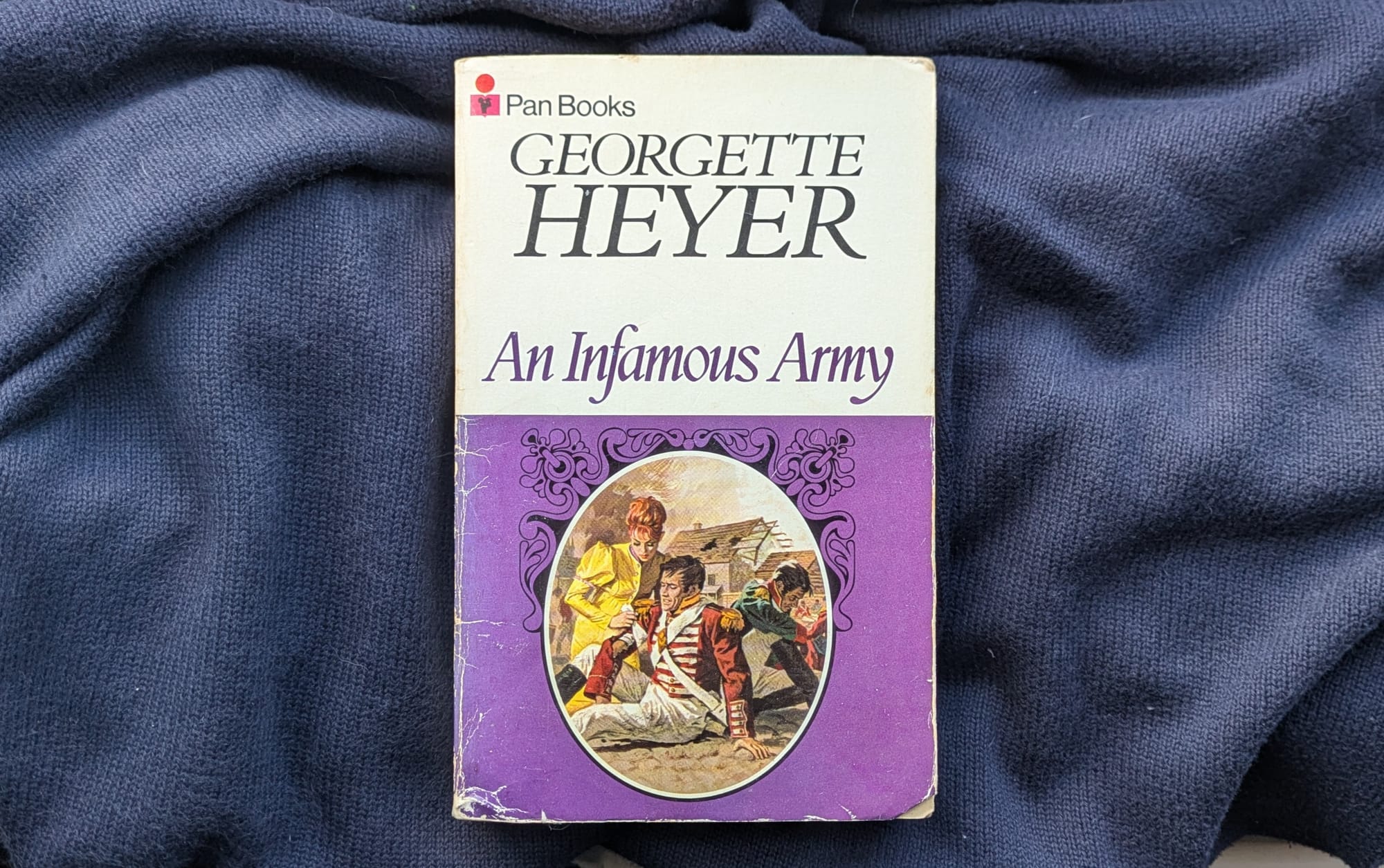
I've had a marvellous time over the past couple of months reading the Alastair-Audley tetralogy: These Old Shades, Devil's Cub, Regency Buck and now An Infamous Army. It's taken me from 1926, when Georgette Heyer was a just-married young author in her early twenties, to 1937, when she was a mother in her mid thirties who had published over a dozen novels. I've read about the 1750s, the 1780s and the 1810s. Wigs and patches have come and gone, although it continues to be a bad idea to wear puce.
I was aware of An Infamous Army by reputation long before I embarked on this project of reading all of Heyer's historical fiction. It's her Waterloo novel, famously providing such an accurate description of the battle that it was recommended to military trainees at Sandhurst. I had heard this factoid so often that I thought it might be a flattering myth, but Heyer biographer Jennifer Kloester was able to confirm the truth of it, learning from a former instructor that army personnel and military historians alike value it as a teaching aid. This would no doubt have delighted Heyer, who in order to write this novel spent many months reading sources, including all of the Duke of Wellington's correspondence, and filled her house with maps of the battlefield.
The book covers most of the "Hundred Days" that elapsed between Napoleon's escape from exile on Elba and his meeting with the Coalition force — Wellington's "infamous army" of the title — in what was then the Netherlands on Sunday 18th June 1815. Just over half of the novel is focused on the social scene in Brussels in the later winter and spring of 1815, as Wellington was assembling troops and commanders in the area. The rest is devoted to a detailed play-by-play of the battle itself, much of it focusing on the activities of Colonel Audley, an aide-de-camp to the Duke.
Audley was a minor character in Regency Buck, the younger brother of the Earl of Worth who marries his ward, Judith, at the end of that book. At the start of An Infamous Army, set three years later, the Worths are taking advantage of the freedom to travel again in Europe, after the Bourbon restoration of 1814. They — along with many other leading members of British society — are in Brussels, holding balls, going on picnics and attending military parades. Also engaged in these pursuits is Lady Barbara Childe, the red-headed granddaughter of Dominic and Mary from Devil's Cub, who are now the Duke and Duchess of Avon. The chronology absolutely doesn't work for them to have got married in the early 1780s and already have a fully-grown and once-widowed granddaughter in 1815, but I don't think Heyer cared about that and nor do I, really.
Audley and Bab, as she is known, are quickly embroiled in a love triangle with "Brussels' most notorious rake", the Comte de Lavisse. Bab has been carrying on with Lavisse for some months, as well as engaging in other scandalous behaviour such as going for morning rides by herself, taking laudanum drops and appearing at a ball with painted toenails. She's also blunt in her speech and uninterested in affecting maidenly virtues she doesn't possess — as a young widow, she has more license than the average debutante. She's probably the closest thing a woman can be to a rake in 1815, in the sense that she truly does not care what anyone else thinks of her social activities or romantic entanglements. She even describes herself this way during a marriage proposal.
Early on, she is introduced to Audley, who is handsome and good at riding and also noble and honourable and reliable enough to excel in an important job in the army. Something in her — probably the part that doesn't enjoy having to take laudanum to be able to sleep at night — realises that she could be truly happy with him. They quickly confess their love and become engaged, only for Bab to rebel against marital expectations while Audley is constantly sent away from Brussels on army business. Theirs is an on-and-off, fight-and-make-up kind of engagement that echoes the unsettled nature of life in the spring of 1815. Everybody knows that a confrontation with Napoleon is coming. Nobody knows exactly when or where it will be. The balls and parties continue, full of handsome young officers who won't live to see the summer. It's a brittle, troubled time.
Then comes the action of the battle, to which Heyer devotes ten whole chapters. Audley's role as aide-de-camp to Wellington allows the reader to see up close how the Duke directs the strategy. Audley also acts as one of Wellington's messengers, taking orders to other commanders in the field, so that we also get to hear different perspectives from across the battlefield. In a nice bit of plotting, when Audley is injured on such an errand, it is Bab's erstwhile lover Lavisse who helps him and completes his mission by delivering the message.
Meanwhile, Bab and Judith are back in Brussels, doing what they can for the columns of wounded men who are being ferried back to the city. I found this section incredibly moving, as Heyer describes the inadequate preparations for medical care (they're still erecting a field hospital in one of the parks 24 hours after the fighting has begun) and how the city's few doctors are overwhelmed by the number of patients. Bab acquits herself well, nursing dying men in the street for hours on end, and we (and Judith) get a glimpse of the decent person who has been hiding under flippancy and flirting all this time. At the conclusion, Bab's drama with Audley is resolved in a satisfactory way that feels true to both of their characters.
I greatly admired An Infamous Army. It's a truly impressive feat of research and description. Some of the sections that deal with the human cost of war, such as those about the plight of the wounded, are excellent. But I didn't enjoy reading it, for the most part. I have never been very interested in the kind of history that dwells in the details of who stood where on a battlefield, nor in the Napoleonic Wars. This book overflows with both of these things: many pages are given over to descriptions of where various regiments are and what all their different uniforms look like, and the jostling for power that is going on between the different powers allied against Napoleon.
I found the first half of the novel, pre-battle, rather slow, and then the battle section itself too stuffed with descriptions of artillery bombardments and troop manoeuvres. The level of precision and detail in the battle section that makes this book a great military teaching aid renders it slow going for a reader like me (that's why this post has taken me two weeks rather than my usual one!). In her author's note, Heyer pre-empts the comparison to Thackeray's Vanity Fair, acknowledging the debt and saying that she hadn't read that novel for years when she wrote An Infamous Army. I likewise haven't read that book in a long time, but from what I remember I think I would have preferred it if Heyer, too, had made Waterloo one episode in a longer, more character-focused, story.
That said, I did enjoy Bab and Audley's love story, although I wished that there was more of it. I also had very little interest in the romantic B-plot, a forbidden marriage between two minor characters. That was all dealt with so sparingly that it felt like Heyer couldn't summon much attention for it either. I liked the glimpses provided of real-life historical figures, such as Lady Caroline Lamb in her outrageously transparent gown and the Duchess of Richmond, who really did hold a grand ball on the eve of the battle. Heyer's deft way of including such characters was much improved from Regency Buck. The cameos at the end of An Infamous Army from the Duke and Duchess of Avon were delightful, given how much I enjoyed their characters in Devil's Cub. I also gained a much better understanding of the scope of Wellington's achievements as a general: he was a politician as much as a tactician and did a superb job of keeping all the European commanders pointing in the right direction instead of fighting over who was going to pay for what. Did I want to know so much about that, though? Not really. My note on one long section about British-Prussian military liaison techniques just reads: "I simply do not care."
To me, this book felt like more of a study aid than an entertaining novel. Well-written as it is, I wouldn't rank it among my favourite Heyers so far. And it will be a long time before I want to read anything else about the relative attractiveness of Hussar uniforms versus Guards uniforms.
Five Other Thoughts
- Judith's focus in the early sections on finding a good husband for Miss Devenish felt rather like Emma Wodehouse's championing of Harriet Smith.
- Puce-watch continues: at a ball a plain young woman in a gown of "particularly harsh puce" stands next to Miss Devenish and makes her look angelic in white by comparison.
- One of my favourite descriptive passages was the one about Bab and Audley galloping down the Allée in Brussels in the early morning light. Beautiful writing.
- We get a small dose of casual anti-semitism in the description of La Catalani, an opera singer Wellington hires as the entertainment for his ball. She is "sharp as a Jew" and haggles fiercely over her fee.
- I did miss the versions of Judith and Peregrine from Regency Buck, who raced curricles and attended cock-fights. They were both rather staid and middle-aged in this book, even though it is set only three years later so they will both be in their twenties. The generational maths of this novel is all out of kilter.
My Favourite Phrases
- A gossipy man settles down for "a comfortable prose" — ie, a chat? — with his hostess.
- There is "nothing more effulgent than his hessians with their swinging tassels" — I suspect Heyer went diving into the thesaurus to find the right adjective for Audley's very shiny boots.
- "Such a quiz of a hat!".
- "Oh, toll-loll!" as a sceptical exclamation.
- Napoleon is described as "a Corsican ogre".
Thanks for reading. I'm making making way through Georgette Heyer's historical novels — you can find all the entries so far here.
You can support my work with a recurring contribution or leave a one-off tip.
Member discussion