Reading Georgette Heyer: Devil's Cub
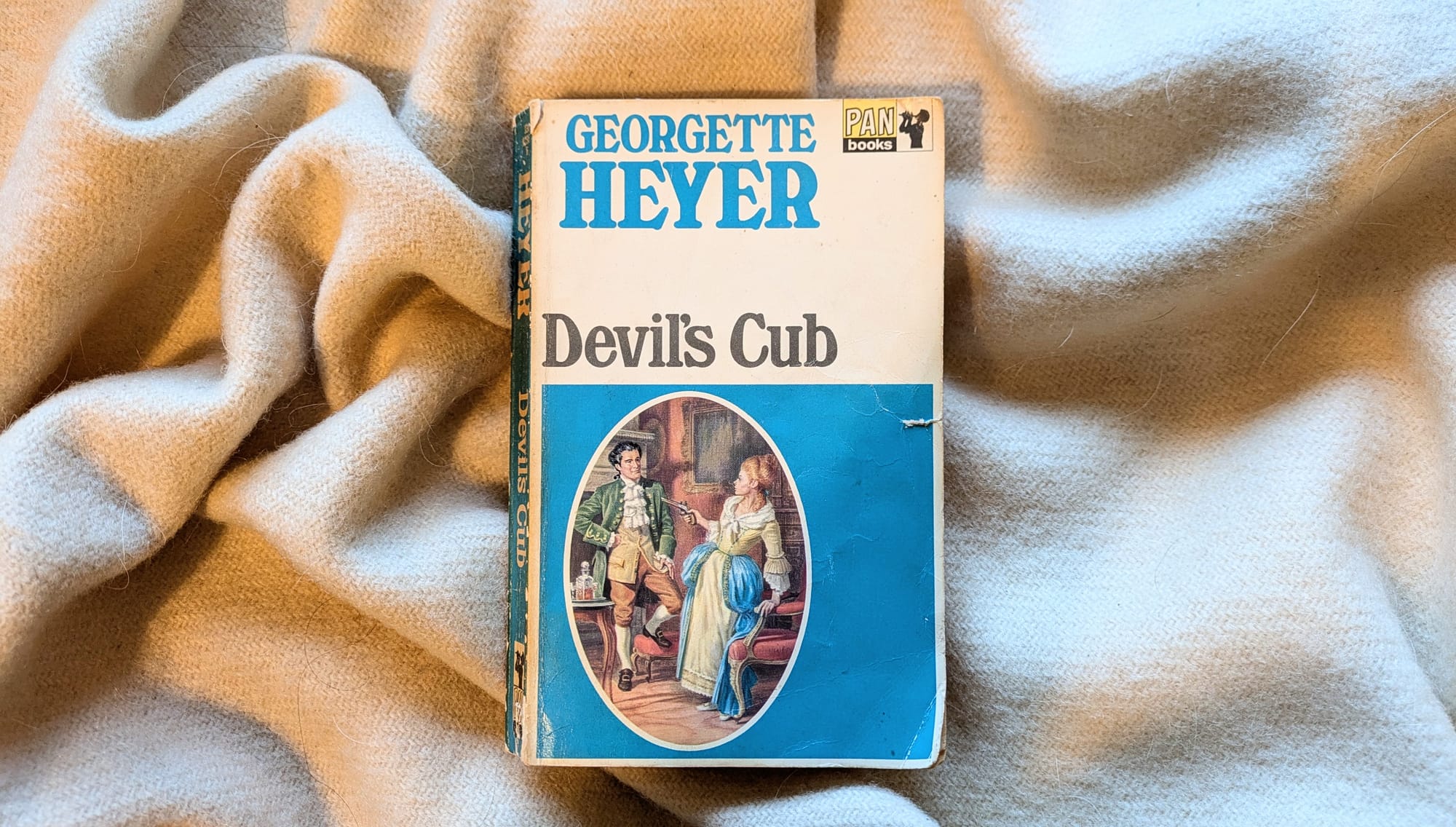
My plan to read my way through Georgette Heyer's historical fiction in chronological order fell apart rather quickly. After my first two titles, The Black Moth and These Old Shades, I was so keen to keep reading about the character of "Devil" that I just skipped to his next book, 1932's Devil's Cub. Simon the Coldheart fans, I promise I will go back and read everything I've missed... Just as soon as I've satiated my desire for the Alastair family's adventures.
Devil's Cub picks up approximately 25 years after the end of These Old Shades. It follows the romantic entanglements of Dominic, Marquis of Vidal, son of Justin and Léonie who meet and fall in love in the previous book. Dominic is a rake with a capital R, and not in the toothless way that some contemporary historical romance writers like to gesture at. His behaviour is vicious and borderline criminal, as Heyer shows us in the arresting opening sequence. Dominic is travelling to a party and casually shoots a highwayman dead on the way, leaving the corpse still bleeding in the road. (I don't know if this is a sly wink at his father's sort-of outlaw origins in The Black Moth, but if it was I liked it.) I also appreciated Dominic's banter with his friend Charles Fox, who I think might be the first real-life historical figure with a speaking part that I have encountered in my reading of Heyer so far. Fox and the other high society types make it clear that they are less shocked by Dominic's habit of extra-judicial murder than they are by the fact that he doesn't bother to clean up the scene afterwards.
This becomes a recurring motif as we follow Dominic through the next few chapters. The denizens of the highest social circles of the early 1780s are not shocked by the same things that we would be today. Thus, Dominic's dalliance with Sophia, a "Cit", aka a bourgeois, middle-class girl, is far less acceptable than the time he spends with more professional paramours. "Opera dancers!", his Aunt Fanny mutters darkly at one point. The same goes for his duelling habit. He has killed at least one person in a duel before, in addition to his drive-by execution in the opening chapter, but it is only when he shoots someone indoors, in an impromptu duel in a gaming hell, that it is felt that he has crossed a line. By teasing out the subtleties of this flexible Georgian moral code, Heyer is able to gesture at the absurdity of Dominic's class without ever mocking or deriding her characters.
This was just one of many wonderful pieces of craft from Heyer that I admired while reading this book. I did feel like I had skipped quite a few phases of her development, because this writer from 1932 has many more tricks up her sleeve than the one who was writing in the early years of the 1920s. The pacing and plotting of this book is magnificent. Every time I thought to myself "I wish Dominic had a straight man to bounce jokes off" or "when is a parent going to show up and meddle in this", my wish was fulfilled on the very next page. Each character has a development arc, too. Dominic goes from dissipated rake to intense, protective fiancé, while Mary, his intended, learns to enjoy herself a little while still keeping her ethics intact. And the menacing appearance of Devil at the end, almost like a fairy godmother, to wrap the whole story up in a bow? Chef's kiss, no notes.
Mary Challoner is a much more complex and well-rounded character than any of the Heyer heroines I have encountered so far. She's the older sister of the lovely Sophia, who we learn is a "yallow-headed chit" with a "frippery brain". Sophia has indeed been blessed with gorgeous golden curls, limpid blue eyes and the ability to flirt like it's her job, whereas Mary is something bordering on a bluestocking. She's had a proper education and finds her mother's insistence on trying to convert Sophia's beauty into a place in the ranks of the nobility quite ridiculous. Mary is sensible and pragmatic, never letting her emotions get the better of her. No hysterics or vapours for her. My kind of girl.
The introduction of the Challoners allows Heyer to explore more class nuances than if the story was set solely among the haute ton. Mary's father was of noble birth and cut off by his family when he married her mother, who is merely the sister of a city merchant. The widowed Mrs Challoner takes her inspiration from Mrs Gunning, the real-life mother of two beauties who in the 1750s sent ripples through society when they managed to marry a Duke and an Earl respectively. What Mrs Challoner seems to have missed, though, is that even though the Gunning sisters were not at all wealthy, they were of aristocratic origin — both their parents were of the Irish nobility, with their mother being the daughter of a viscount. Sophia might be beautiful, but with her vulgar manners and nothing but a "bundle of Cits" in her family tree, she stands no chance.
The incident that pushes Mary out of her comfortable milieu and onto the path to wedded bliss is a typically cunning piece of work by Heyer. A note arrives addressed to "Miss Challoner", which is delivered to her as the eldest daughter of the house. It's from Dominic and was meant for Sophia, since it gives all the details of their planned flight from London together — he thinks they're going to have a lovely roll in the hay while he lives down the shame of his latest duel, while Sophia thinks she can trick him to the altar somehow and become a Marquess. Not only does the note allow Mary to pre-empt the scheme, taking Sophia's place to protect her sister's reputation and marital prospects, it also shows how little regard for Mary Dominic has early on in the book. He has forgotten that she exists at all, hence the application of her rightful title to her younger sister. This gives their early scenes together on the road greater tension and makes the eventual resolution feel completely earned.
What Devil's Cub has that my previous Heyer reads lacked is a very capable handling of shadow and light. Every sweet, happy moment has a drop of darkness to it, and every melodramatic scene is undercut with humour. From Dominic's first entrance as a cold-blooded lout to Mary's very serious conversation with Devil at the end, there is always something that makes the reader smile. By the time she published Devil's Cub, Heyer was the author of (I think?) eleven other novels. She had clearly learned from the writing of every one of them, because this one is a triumph.
Five Other Thoughts
- The secondary couple, Dominic's cousin Juliana and her self-effacing beau Frederick, were my least favourite thing about this book. The latter amply demonstrates that there's nothing so annoying as someone who says "no, whatever you want" when you're trying to make a plan. It's a performance of courtesy and humility that actually throws the onus on the other person to do all the thinking and decision making. No wonder Mary comes to find him infuriating. An attractive romantic lead is also one who can think for themself! I have to imagine that Juliana will force him to be a little more decisive in future.
- I enjoyed the scene where Dominic involuntarily snaps the sticks of Juliana's fan, so upset is he at the very idea that a lady of his, ie Mary, would ever flirt with another man. It's very like his father's habit of crushing snuffboxes when angry.
- I'm getting the sense that Heyer really didn't like the colour puce. Only terrible bores — like Mary's cousin and unwelcome suitor Joshua — wear puce. And someone always comments on how much it doesn't suit them.
- I adored Uncle Rupert's love affair with his six dozen bottles of port. I hope they all got home safely.
- I felt slightly offended on behalf of the town of Dijon. I'm sure it is a nice place! The other characters were offensively astonished that someone as rich and fashionable Dominic would ever go there.
My Favourite Phrases
- Juliana is a "rattle-pate".
- Two good financial words — "dunning" and "milleleva" (I think the latter is a bit like a "pony" ie an amount of money one might lose while gambling).
- Mary is at one point described as "Miss Prunes and Prisms".
- A "sulky", a type of carriage.
- Dominic says to Mary that her conduct in running away with him was that of "the veriest trollop".
Thanks for reading. I'm making making way through Georgette Heyer's historical novels — you can find all the entries so far here.
You can support my work with a recurring contribution or leave a one-off tip.
Member discussion